
Google Just Turned AI Answers Into Ad Space. Your Paid Search Strategy Doesn't Know It Yet.
75 million daily users now see sponsored placements woven into AI-generated product recommendations. Most paid search strategies were built for a world that no longer exists.

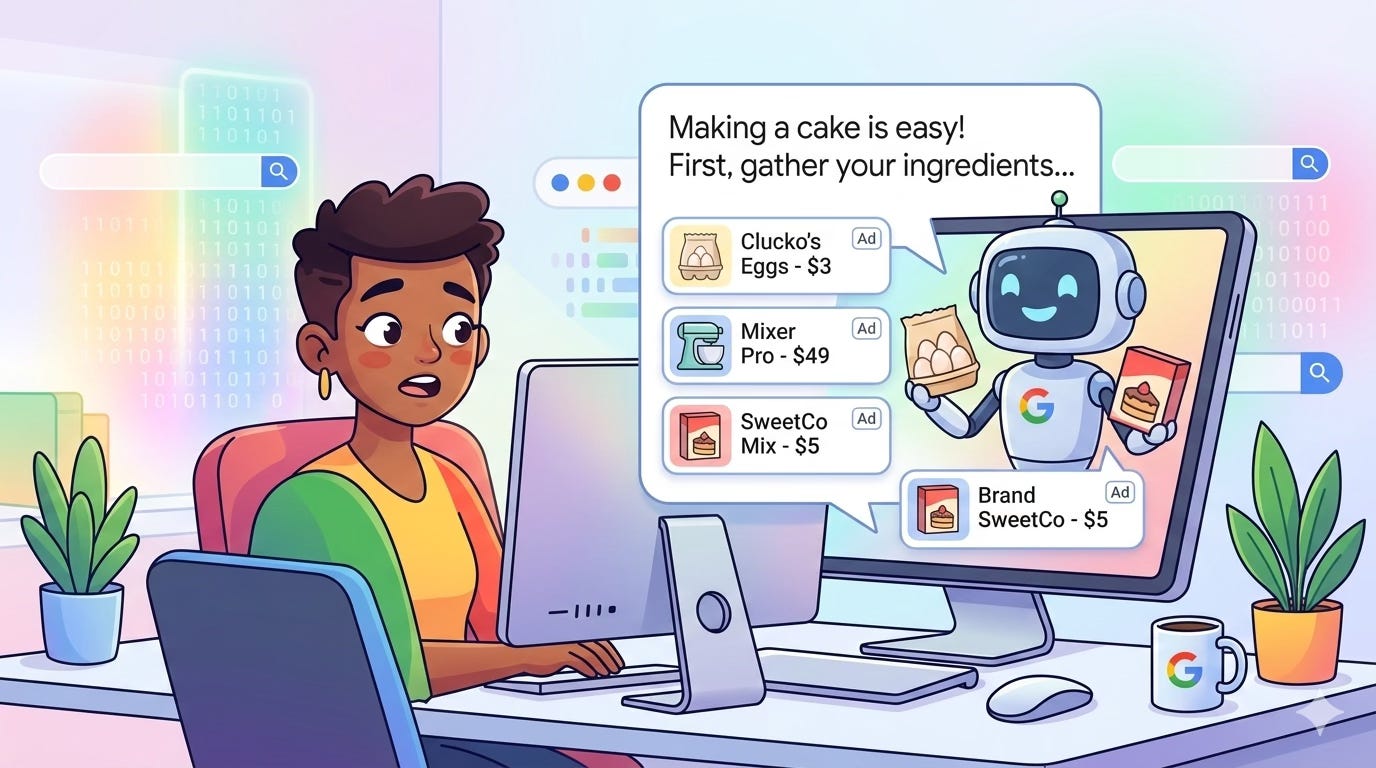
For about two years, marketers operated on a comfortable assumption: whatever else AI was disrupting, the answers that AI interfaces generated were at least unsponsored. The AI was recommending, not advertising. That distinction felt meaningful. It was the last environment in digital marketing where a brand could appear on merit alone.
On February 11, 2026, Google formalized the end of that era.
Shopping ads now appear inside Google’s conversational search experience (AI Mode), the one that handles the longer, more complex queries where users are actually working through purchase decisions. Sponsored placements sit inside AI-generated responses, clearly labelled, but woven into the same interface that just told the user which headphones to consider, which brand reviewers recommend, and which retailers stock the one they want. Google’s VP of Ads and Commerce, Vidhya Srinivasan, framed it as the logical next step in a year defined by “agentic commerce.” The infrastructure already exists: the Universal Commerce Protocol, launched in January 2026 with Target, Walmart, Shopify, Etsy, and Wayfair, allows AI agents to complete purchases directly inside AI Mode and the Gemini app, without the user ever visiting a product page.
The funnel didn’t just get compressed. It moved, and most paid search strategies are still calibrated for where it used to be.
What Actually Changed
AI Mode is Google’s fully conversational search interface. It is xxdistinct from AI Overviews, which appear above standard organic results. AI Mode handles multi-step, comparison-oriented queries where users refine and interrogate rather than simply asking for a single answer. It has reached over 75 million daily active users across 93 languages.
The new shopping ad format places sponsored listings inside AI Mode’s responses at what Google describes as “product discovery moments.” A user asks a conversational question about headphones (maybe comparing brands, exploring use cases, and asking follow-ups), and within the AI-generated response, sponsored listings from retailers like Target and B&H appear alongside organic product recommendations. The query drives the ad placement, not a keyword match. In AI Mode, longer, more conversational queries provide what Google explicitly calls “richer intent signals,” which it says enable more precise ad delivery at the moment of decision.
That’s not a minor optimisation. The user who asks “best noise-cancelling headphones for open-plan offices under $200” is telling you something qualitatively different from the user who searches “headphones.” Google is now monetising that qualitative difference within a conversational interface, where the ad appears not as a sidebar but as a contextual element within the answer itself.
The Trust Architecture Problem
For twenty-five years, the contract of search advertising has been legibility: users know the ads are ads because they appear in a distinct zone, visually separated from organic results. Inside a conversational AI interface, that architecture is being rebuilt from scratch.
When a user is mid-conversation with an AI system, working through a purchase decision in a back-and-forth that feels more like consulting an advisor than searching a catalog, the cognitive context for processing a “Sponsored” label is different. The AI has established trust. The sponsored placement arrives inside that trust, not adjacent to it.
Google says these placements are clearly labelled, and the screenshots confirm it. But consider the user’s perspective: the AI recommended a product. Within the same response window, sponsored listings appear from retailers stocking that product. The organic response and the advertising layer are architecturally separate - Google has been consistent on this. Whether the label architecture does the cognitive work required to keep those two things distinct is a different question.
Perplexity concluded that even clearly labelled ads could undermine the trustworthiness of AI-generated answers, and stepped back from advertising within responses. OpenAI has promised that ads will be clearly separated from model responses. Anthropic has positioned Claude as ad-free entirely. Google has made the opposite bet. It may prove right, since users adapt to new ad formats faster than expected. But the brand safety question belongs on your agenda regardless of how the trust question resolves.
The Measurement Gap
The more immediate problem for most teams is structural, not philosophical. As of now, advertisers cannot bid specifically for AI Mode placements as a distinct targeting option, and cannot see granular performance metrics for AI Mode impressions separately from other placement types. Google’s AI determines contextual relevance - the advertisers set parameters, but the machine makes the call. This is the same “black box” dynamic from Performance Max, now applied to a new surface.
The dynamic that complicates attribution: brands cited in AI Mode’s organic recommendations (separate from the paid placement) see 35% higher organic click-through rates (CTR) and 91% higher paid CTR compared to non-cited brands on the same queries, according to Seer Interactive’s analysis of over 25 million impressions. Your organic AI citation status affects your paid performance in the same interface. They are not independent; they interact, and most measurement stacks do not account for that interaction yet.
The Agentic Commerce Layer
The shopping ads story is the surface layer of a more significant structural shift.
The Universal Commerce Protocol is the infrastructure beneath: a standardised interface that allows AI agents to discover products and complete transactions across retail platforms without custom integrations. Target and Walmart already enable checkout directly within Google’s Gemini app and AI Mode. The “product discovery moment” Google is monetising can now also be a transaction moment, completing the purchase entirely within the AI interface, without the user ever reaching your site.
For brands that have spent years building owned commerce capabilities and first-party data assets, this is the strategic question beneath the paid search question: if transactions complete within Google’s AI ecosystem, the data, the first-party relationship, and the post-purchase communication all flow through Google’s infrastructure rather than yours. That is a structural shift in where customer relationships form.
What Your Strategy Needs to Address
Four questions that belong on the agenda now, while competition on this surface is still forming.
1. Where does your brand appear in AI Mode’s organic responses?
Before considering paid placements, check whether your brand is cited in the AI recommendation layer. Run the conversational, comparison-oriented queries your buyers actually use. Document what the AI recommends, how your brand is characterised, and where it sits relative to competitors. The organic and paid positions interact, and you need to know both.
2. Are your Shopping campaigns technically ready?
Your existing Google Shopping campaigns are the feed that powers AI Mode’s sponsored placements. Product data quality, title structure, feed optimisation, and bidding strategy all affect AI Mode performance, but through a system calibrated to conversational intent signals rather than keyword matching. Review your feed for that logic.
3. What does your measurement architecture miss?
If you’re not isolating AI Mode attribution from broader Shopping or Performance Max numbers, you’re averaging a signal you can’t yet read. Work with your analytics team to create that separation, however imperfect, so you can see whether this surface performs differently from what you’ve assumed.
4. Who owns the intersection?
In most organisations, paid search sits with performance marketing, GEO sits nowhere, and brand safety sits with a separate team not tracking this surface. AI Mode placements are a paid, organic, and brand-safety problem simultaneously. The February 11 announcement is a prompt to get those three groups in the same conversation.
Ethicore Advisors Author’s Note
Google, OpenAI, and the broader AI advertising ecosystem are collectively answering the same question: are AI-generated answers editorial, or advertising real estate? The answer, it turns out, is both. OpenAI confirmed Expedia, Qualcomm, Best Buy, and Enterprise Mobility as its first ChatGPT advertisers on February 20. The era of unsponsored AI answers is ending faster than most marketing teams planned for.
The brands that navigate this well will be the ones that understand both layers of AI visibility (organic citations and paid placements) and have built measurement frameworks that keep both in view. This is a new surface. The window to build that strategy before it gets crowded is still open, but shorter than it was last month.
Does your paid search strategy currently account for AI Mode placements? And do you know how your brand appears in AI Mode’s organic recommendations, separate from your paid activity? The gap between those two things is where most brands are flying blind right now.
Craig McDonogh is the founder of Ethicore Advisors and the author of the forthcoming book “Guardrails: How to Embrace AI Without Damaging Your Brand.” He advises CMOs and marketing leaders on AI governance, reputational risk, and strategic positioning in an AI-driven market.