
The CMO’s Implementation Guide to Building An AI Governance Framework
The step-by-step playbook for establishing the foundation that makes ethical AI deployment possible.

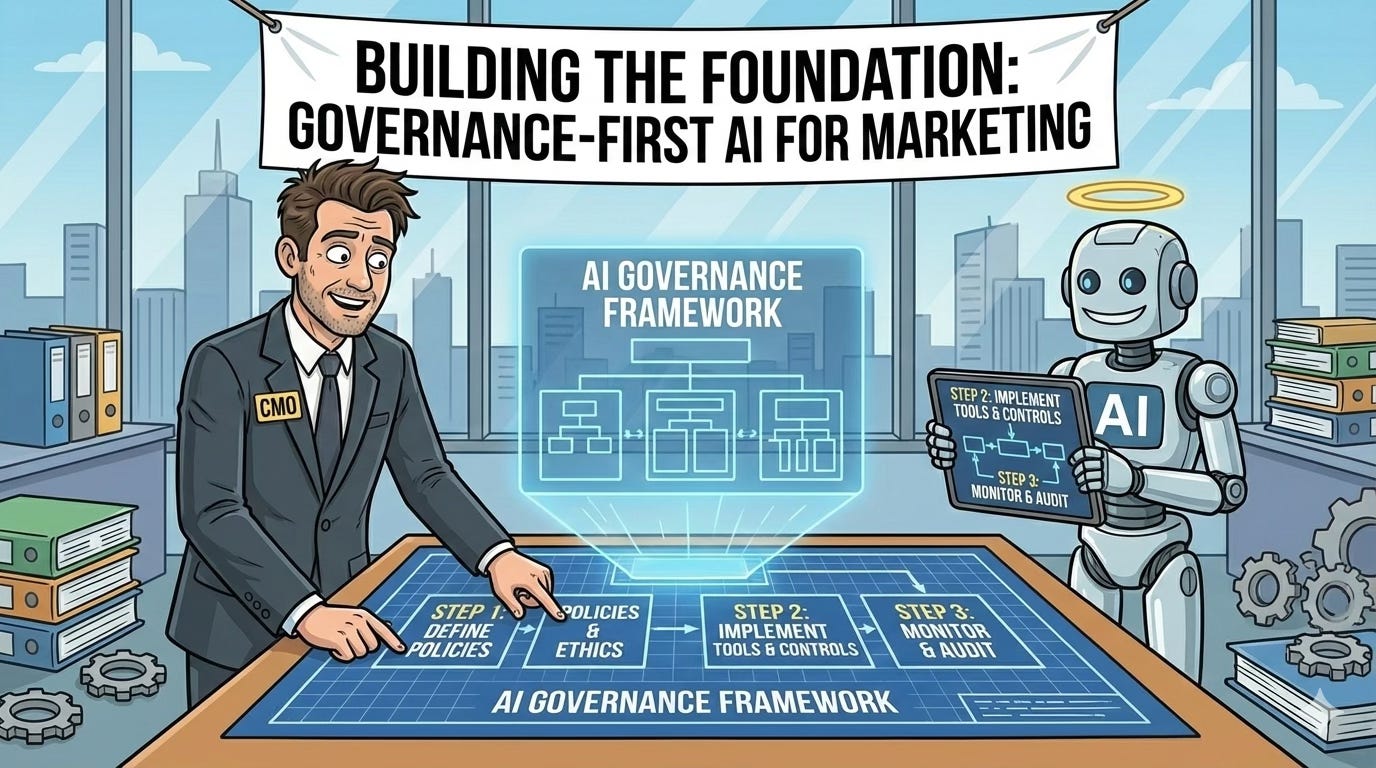
In my last post, I ranked governance-first AI frameworks as the #1 tactic CMOs should deploy. Because organizations with AI governance frameworks report 290% higher trust scores and 180% lower compliance costs. But more fundamentally, every other ethical AI tactic depends on governance as the foundation.
The problem is that only 22% of organizations have established clear guidelines for AI in automated decision-making. That means 78% are deploying AI without frameworks, accumulating risk with every deployment.
This isn’t theoretical. Sixty-nine percent of employees and 66% of consumers say it’s important that companies disclose their AI governance framework. When you can’t articulate yours, you’re losing trust before you’ve deployed a single campaign.
This guide shows you how to build governance that accelerates AI deployment instead of blocking it. Because done right, governance isn’t red tape - it’s competitive infrastructure.
Step 1: Assemble Your Cross-Functional AI Council
Governance fails when owned by one function. AI governance must be cross-functional, bringing together perspectives that see different risks.
Core members:
Marketing Lead (You): Brand risk, customer trust, campaign effectiveness. You’re sponsoring this because marketing deploys the most customer-facing AI.
Legal Counsel: Interprets regulations, flags compliance gaps. Privacy professionals are frequently asked to take AI governance roles, and you should leverage this.
Data/Analytics Lead: Data quality, privacy management, bias evaluation. When privacy leads AI governance, organizations show higher confidence.
IT/Security (CISO/CIO): Technical feasibility, security, vendor tools. CMO-CIO partnerships transform AI from shadow IT into a managed capability.
Product/Operations: Customer journey impact, operational integration.
Ethics Representative: Raises questions others miss, challenges assumptions.
Cadence: Bi-weekly initially, monthly once operational. Define decision gates and required artifacts upfront.
The council must have the authority to approve/reject initiatives. Without teeth, governance is theater.
Step 2: Document Your AI Principles
Before governing AI, articulate what you’re governing toward. Establish ethical principles guiding development and deployment. Make sure you address:
Transparency - when/how we disclose AI use
Fairness - how we prevent discrimination
Privacy - data minimization approach
Accountability - where human oversight is mandatory
Safety - what uses are prohibited regardless of performance
Example: One retail CMO established: “We disclose AI use in customer-facing contexts. We never use AI to exploit emotional vulnerability. We audit quarterly for demographic bias. Humans approve all campaign deployment.” That’s 40 words. Principles requiring interpretation aren’t principles - they’re mission statements.
Stakeholder input matters. Marketing companies have different considerations than healthcare organizations.
Step 3: Create Your AI Use Case Inventory
You can’t govern what you don’t know about. Take inventory of current and planned AI.
Audit current usage: Which tools teams use (include shadow AI tools adopted without IT approval), what data they access, what decisions they make or influence, and who owns each implementation.
Map future deployments: What AI is planned, what problems it solves, and expected impact.
Risk classification: Tier each use case by risk. High-risk uses (customer-facing, personal data, automated decisions) need more oversight than low-risk uses (internal productivity, non-sensitive data).
This inventory becomes your governance roadmap, showing where oversight is most urgent.
Step 4: Establish Decision Gates and Approval Workflows
Define clear decision gates so teams know when approval is required.
Low-risk AI (internal productivity): Manager approval, IT security review, proceed.
Medium-risk AI (marketing analytics, internal automation): Department lead approval, data privacy review, IT security review, council notification (no approval needed), proceed.
High-risk AI (customer-facing, automated decisions, personal data): Business sponsor documents purpose, data sources, ethical boundaries, and success metrics. Data lead conducts bias assessment. Legal reviews compliance. Council approves/rejects. Implementation with monitoring requirements. Regular audits.
Document required artifacts for each gate. Council approval is meaningless without specifying what information enables decisions.
Step 5: Write Your AI Usage Policy
Your policy translates principles into actionable rules, and should specify:
Approved uses - content drafting, A/B testing, predictive analytics, personalization with consent, chatbots with disclosure
Prohibited uses - emotional manipulation, undisclosed automation, decisions without human review, bias-prone applications without audits
Data restrictions - never use AI on: sensitive personal data without consent, confidential business information in external tools, data we lack rights to use
Disclosure requirements - always disclose when: generating customer content, making automated decisions affecting customers, using customer data for personalization
Human oversight - humans must review: customer communications before sending, campaign targeting before launch, content before publication, and high-stakes decisions.
Example policy excerpt: “AI-generated content requires human review for accuracy and brand alignment before publication. We disclose AI assistance when contextually appropriate. We never deploy AI targeting without quarterly bias audits. Marketing email campaigns need human approval before sending - campaigns cannot be fully automated.”
BCG research shows frameworks should define which decisions AI can make autonomously and where human oversight is mandatory.
Step 6: Implement Monitoring and Audit Protocols
Quarterly audits assess: bias/fairness (demographic consistency), performance drift (accuracy degradation), policy compliance (workflow adherence, shadow AI), security/privacy (breaches, controls), output quality (accuracy, brand alignment).
Assign ownership: data stewards, algorithm auditors, compliance officers.
Step 7: Build Training and AI Literacy Programs
AI literacy enables safe deployment. Role-based training: all staff (basics, policy, approval triggers), content creators (tools, fact-checking, attribution), campaign managers (targeting audits, monitoring), analysts (bias detection, privacy controls).
Initial onboarding, quarterly refreshers, updates when policy changes.
Step 8: Establish Vendor Evaluation Criteria
Vendor selection requires scrutiny beyond features. Evaluate: data practices (collection, storage, training use), security/compliance (SOC 2, GDPR), transparency (explainability), bias mitigation (fairness testing), control (review outputs, disable features), contracts (data ownership, cancellation terms).
Step 9: Create Incident Response Protocols
AI will fail. Plan should cover: detection (monitoring), assessment (severity, impact), containment (pause/disable), communication (internal/external), remediation (root cause, corrections), documentation (lessons learned).
Run crisis simulations with CMO-CISO teams. Practice scenarios: biased targeting, data breach, harmful chatbot advice.
Step 10: Define Success Metrics and Report to Leadership
Track KPIs: process (approval rates, review time), compliance (violations, audit findings), risk (incidents prevented, bias detected), business (deployment velocity, productivity, trust scores).
Monthly to council, quarterly to executives, annual to board. Frame governance as an enabler.
Common Implementation Pitfalls
Governance as an afterthought (build first, then deploy). Too much bureaucracy (right-size to risk). Lack of executive support (secure CEO backing). Ignoring shadow AI (create approved alternatives). No teeth (council needs authority).
Timeline: 90-Day Implementation
Weeks 1-2: Assemble council, review current AI
Weeks 3-4: Draft principles/policy
Weeks 5-6: Finalize policy, establish workflows
Weeks 7-8: Initial training, audit existing AI
Weeks 9-10: Pilot approval process
Weeks 11-12:Full rollout
Month 4+: Regular operations.
Sixty-two percent of leaders are very concerned about AI compliance. Organizations that address this proactively build competitive advantages.
Ethicore Advisors Author’s Note
At Ethicore Advisors, clients ask whether governance is just going to slow them down, and my response is always “Only if you build it wrong.”
The CMOs who succeed with AI governance aren’t those with the most restrictive policies. They’re those with the clearest processes and frameworks that answer “can I do this?” quickly and consistently.
The gap between AI capability and AI deployment isn’t technical. It’s organizational. It’s the difference between “we could use AI for this” and “we’ve established it’s safe and approved to use AI for this.” Governance closes that gap. It transforms AI from scattered experiments into a systematic capability driving competitive advantage.
This guide provides the playbook. The question is whether you’ll implement it before or after your first AI disaster. Because right now, while 78% of organizations lack clear AI guidelines, building governance isn’t just responsible - it’s differentiating.
The CMOs who’ll dominate 2026 aren’t those deploying the most AI. They’re those deploying AI most responsibly, and responsibility starts with governance.