
The Five Question CMO AI Credibility Test
Your Practical Friday post from Ethicore Advisors

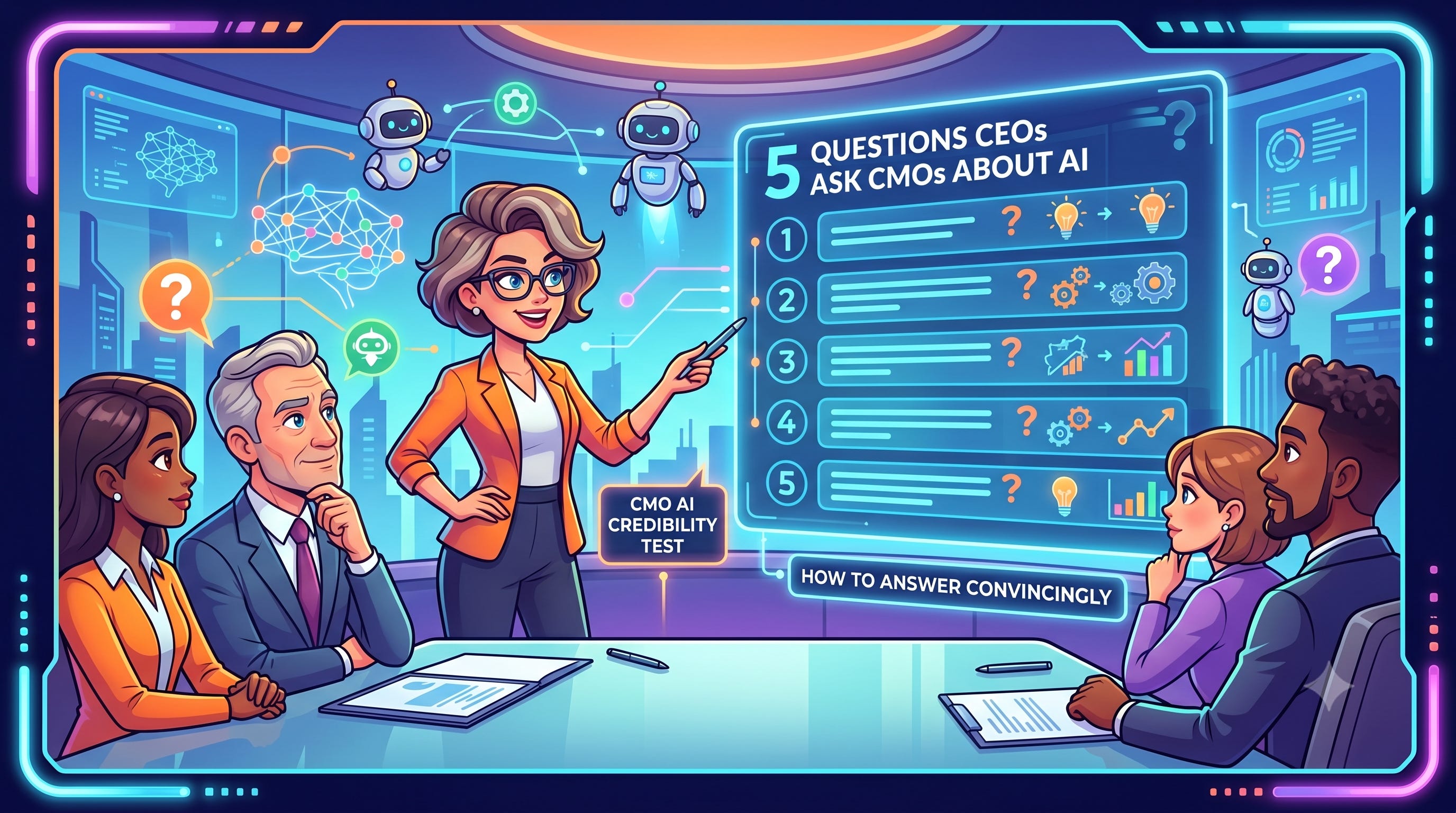
The boardroom is changing its questions. Not long ago, a CMO could walk into a quarterly review, cite a handful of AI efficiency wins, and get a satisfied nod. But that window is closing.
Gartner’s latest CMO Spend Survey, released this month, found that while 70% of marketing organizations say becoming an AI leader is a critical 2026 goal, the same 70% admit their internal processes aren’t ready to support it. Boards and CEOs are starting to notice that gap, and some are asking pointed questions about it.
At the same time, the AI Research Innovation and Accountability Act is advancing through Congress, calling for greater transparency, accountability, and enforceable testing standards for companies deploying high-risk AI systems. Accountability language is entering the mainstream. If it hasn’t reached your boardroom yet, it’s on its way.
So here are the five questions your CEO or a board member is increasingly likely to ask … and what a credible answer actually looks like.
1. “Who owns AI governance in marketing?”
The wrong answer: “It’s a cross-functional thing.” That’s code for nobody owns it.
A credible answer names a person or a team, describes what they’re accountable for, and explains how that accountability connects upward to the CMO.
2. “What’s our exposure if an AI-generated campaign causes harm?”
This one tends to produce uncomfortable silence. Most CMOs haven’t worked through the liability question - who bears responsibility if your AI-personalized ad targets someone in a protected class, or your AI-generated content makes a claim the product can’t support.
A credible answer describes your review process, your sign-off criteria, and what you do when something goes wrong. “We haven’t had a problem yet” is not a governance posture.
3. “Do we know what AI our agencies are using on our behalf?”
Gartner’s analysts specifically flagged the need for CMOs to hold agencies accountable for governance and demonstrated value, yet most agency contracts were written before generative AI existed. If you don’t know what your agency partners are running on your brand, that’s a due diligence gap with real reputational risk attached.
A credible answer references your vendor AI disclosure requirements and what you do when an agency can’t or won’t answer the question.
4. “How do we know our AI outputs are accurate?”
Not a trick question. Your CEO genuinely wants to know whether someone is checking. Gartner’s data shows that marketing organizations invest in AI tools faster than they build the governance and processes needed to scale them, which means a lot of content is going out the door without a systematic quality check.
A credible answer describes your output validation process and where human review sits in the workflow.
5. “What would we do if a regulator asked us to account for our AI use?”
This is the stress test. Companies that deploy AI for marketing are increasingly subject to antitrust, consumer protection, and false claims scrutiny - even without a single unified federal AI statute in place. State-level enforcement is accelerating, and documentation matters.
A credible answer means you have an inventory of your AI tools, their purposes, their data inputs, and the decisions they influence. If that inventory doesn’t exist, that’s your first deliverable.
The Bottom Line
None of these questions require a PhD in machine learning. They require the same thing boards have always demanded of functional leaders: ownership, process, and accountability. The CMOs who can answer them clearly will look very different from those who can’t … and boards are increasingly in a position to tell the difference.
Ethicore Advisors Author’s Note
These five questions are sequenced to escalate in difficulty - ownership first (structural), then liability (legal exposure), then agency supply chain (operational blind spot), then output accuracy (process), then regulatory readiness (existential). That order mirrors how a board conversation would naturally intensify.
Craig McDonogh is the founder of Ethicore Advisors and the author of Guardrails: How to Embrace AI Without Damaging Your Brand (October 2026).