
The Pope Just Published the Most Consequential AI Ethics Document of 2026
... and it has nothing to do with God

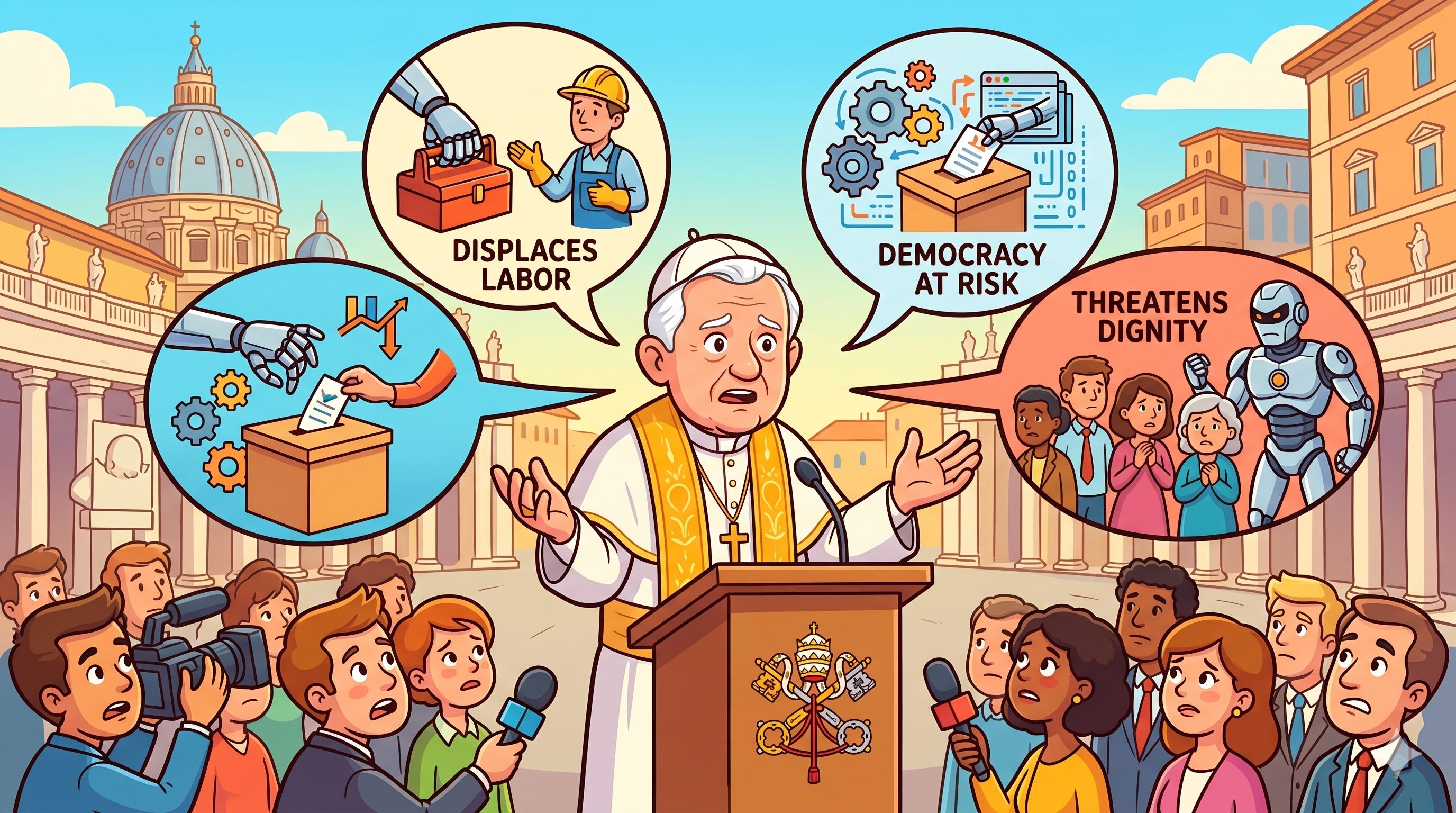
Pope Leo XIV released “Magnifica Humanitas” yesterday - a 42,300-word encyclical addressed to 1.4 billion Catholics and the world. Its central claim is that AI in the hands of a profit-seeking few threatens human dignity, labor, and democratic accountability. The institutional weight behind that argument is unlike anything the AI governance conversation has seen before.
I was brought up Catholic. Went to Catholic schools, was taught by Jesuits, did my First Communion, Confirmation, and all the things that a good Catholic boy does. But that was a long time ago, and I have to admit that I haven’t paid much attention to the church in quite a few years. But yesterday, Pope Leo XIV released the first encyclical of his papacy - “Magnifica Humanitas: On Safeguarding the Human Person in the Time of Artificial Intelligence.” and I started paying attention again. At 42,300 words, it is one of the most extensive documents the Vatican has produced on a contemporary issue in decades. It is addressed to Catholics (1.4 billion people, or roughly 17% of the global population), but it is also explicitly addressed to governments, technology corporations, and global institutions.
The co-founder of Anthropic, Chris Olah, spoke at the encyclical’s presentation in Vatican City. He told the assembled audience that AI companies work “inside a set of incentives and constraints that can sometimes conflict with doing the right thing,” and that he welcomed input from the Catholic Church to “push events in a better direction.” “The questions raised by AI,” he said, “are bigger than the AI research community.”
That sentence, from one of the senior-most people at the most safety-focused AI company in the world, delivered at the Vatican, alongside the Pope, is the marker that this is not a symbolic event. It is a substantive one.
What the Encyclical Actually Argues
Leo’s framework rests on a specific concern that is structural rather than theological: the concentration of AI capability in a small number of private actors whose incentive is commercial dominance rather than human welfare.
“As with every major technological shift, AI tends to amplify the power of those who already possess economic resources, expertise, and access to data,” he wrote. The concern is not that AI is immoral. It is that AI-driven concentration of power (economic, geopolitical, informational) that, in the digital era, reproduces the same dynamics that Catholic social teaching has addressed since Leo XIII’s “Rerum Novarum” in 1891: the subordination of human dignity to the logic of capital accumulation.
Leo XIV signed his encyclical on May 15, 2026 - the 135th anniversary of Rerum Novarum’s release. His papal name deliberately references Leo XIII: that pope addressed the industrial revolution’s social consequences, and Leo XIV has drawn the same comparison to AI, describing it as ushering in “a new industrial revolution.” The Rerum Novarum framing is not decorative. It is an argument that the ethical framework of Catholic social teaching developed to address industrial capitalism (workers’ rights, fair wages, limits on concentrated economic power) applies to AI, adapted for the digital era.
Concretely, the encyclical calls for: government regulation of AI rather than industry self-governance; protection of workers from AI-driven displacement; limits on AI in autonomous weapons systems; safeguards for children; and the requirement that AI data ownership not be left solely in private hands. It warns against “a race for ever more powerful algorithms and larger datasets” driven by “the desire to secure geopolitical or commercial dominance.” It calls for AI to be “disarmed.”
That last formulation is worth noting. Not regulated, not governed, not made safer … disarmed. The language of the encyclical is not technical. It is moral and political in the most direct sense.
Why the Institutional Weight Matters
This series covered the Faith-AI Covenant roundtable last month and noted that interfaith principles lack governance value without enforcement mechanisms. The encyclical is a different kind of document.
An encyclical is one of the highest forms of papal teaching. It is not just a position paper or a discussion document. It is an authoritative statement of the Church’s position on a matter of moral significance, addressed to the faithful and expected to inform their conduct. When Leo XIII wrote Rerum Novarum, it did not merely describe a position on labor rights - it contributed to the formation of Christian democratic political parties, labor union movements, and social welfare policies across Europe and Latin America. The institutional translation of papal teaching into political and legal change is a documented historical process.
The question for AI governance is whether “Magnifica Humanitas” functions similarly. The conditions are different, since the secular character of most AI-relevant governments means papal authority cannot simply translate into legislative action as it did in 19th-century confessional states. But the encyclical’s reach into Latin America, sub-Saharan Africa, Southern Europe, and the Philippines (regions where Catholic social teaching has significant legislative influence) is not trivial.
The more immediate governance effect may be in corporate culture. The Vatican’s engagement with Anthropic signals that the most safety-focused frontier AI lab views this institutional voice as a resource rather than an obstacle. That positioning is significant for the broader industry, where the dominant frame has been that conversations about ethics are a drag on innovation. The Pope’s encyclical, endorsed by Anthropic’s co-founder in person at the Vatican, is a data point against that frame.
What This Means for CMOs and Marketing Organizations
The encyclical’s specific claims about labor, data concentration, and human dignity map onto marketing practice in ways that are worth naming.
Labor. Leo’s concern about AI-driven displacement is not abstract for marketing organizations. The CMO post in this series two weeks ago named the same dynamic: AI agents executing budget reallocation, campaign management, and optimization functions that previously required human judgment and human employment. The encyclical frames this displacement not as economic progress but as a dignity issue - the subordination of human work to efficiency logic. The AI rebellion post from last week documented the commencement booing and the polling data. The encyclical gives that backlash institutional theological grounding for 1.4 billion people.
Data concentration. Leo’s argument that AI data ownership must not be left solely in private hands connects directly to the B2AI discussion in this series. If AI agents are making purchase decisions on behalf of consumers using behavioral data held by a small number of corporations, the encyclical’s concern about power concentration is structurally accurate regardless of its theological framing. The CMO who is building a strategy around owning customer data and deploying it through AI agents is participating in exactly the dynamic the encyclical identifies as problematic. That does not make the strategy wrong, but it means the reputational and regulatory scrutiny of that strategy is about to intensify significantly.
Human dignity in customer-facing AI. The encyclical’s insistence that AI must serve human development rather than replace human relationships applies specifically to the AI-powered customer experiences that marketing teams are building. The chatbot that handles customer service without a human escalation path. The personalization engine that optimizes engagement without asking whether the engagement is good for the customer. The recommendation system that maximizes purchase frequency without distinguishing between healthy and compulsive buying behavior. These are not theological questions. They are exactly the questions that regulatory frameworks like the EU AI Act’s prohibited practices, the FTC’s deceptive practices authority are beginning to address in legal terms.
The encyclical does not have legal force. But it has cultural force, regulatory momentum, and 1.4 billion addresses. For brands operating in markets with significant Catholic populations, the ethical framing the encyclical provides for labor displacement, data concentration, and AI’s treatment of human dignity will shape the political environment in which AI regulation develops.
The Most Important Line in the Document
The encyclical was released yesterday, and 42,300 words is a significant read. But one passage, circulating widely since the document dropped this morning, captures the argument in its sharpest form:
Leo writes that the main challenge as civilization grapples with AI is “remaining profoundly human.”
Three words. They contain everything the governance conversation has been trying to convey in technical, regulatory, and commercial terms over the past three years. They are also the most useful test for any marketing AI deployment: would a reasonable person looking at what this system does, in the way it does it, conclude that the organization behind it is committed to remaining profoundly human in how it treats its customers, its employees, and the communities it operates in?
That test is not in the EU AI Act. It is not in the Colorado ADMT framework. It is not in the FTC’s deceptive practices guidance. But it is in the way that 1.4 billion people have just been invited to think about AI … including a significant proportion of your customers, your employees, and your regulators.
Build accordingly.
Ethicore Advisors Author’s Note
Craig McDonogh is the founder of Ethicore Advisors and the author of the forthcoming book “Guardrails: How to Embrace AI Without Damaging Your Brand.” He advises CMOs and senior marketing leaders on AI governance, reputational risk, and responsible deployment.
If your organization is building AI governance frameworks that take the full social and institutional context of AI seriously, Ethicore Advisors is where that conversation starts.