
We Now Require Expert Testimony to Believe a Photo
That’s a marketing problem

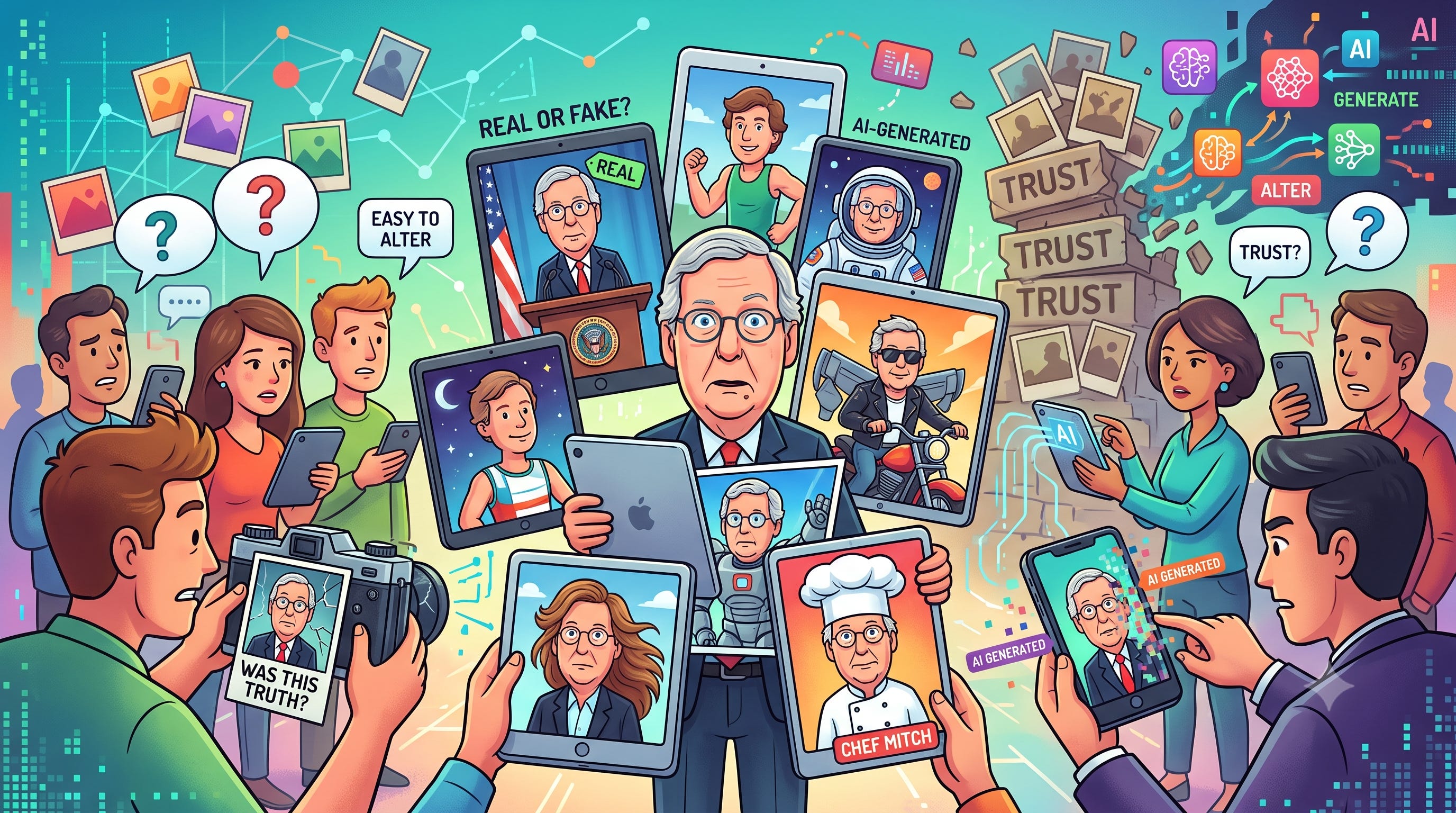
On July 12, Senator Mitch McConnell’s office released a photograph showing the 84-year-old Kentucky Republican sitting up in a hospital bed, smiling beside his wife, Elaine Chao, holding that day’s Washington Post open to the sports section. He had been hospitalized since June 14 after a fall at home. The photo was meant to settle five weeks of mounting speculation about his health. Instead, it generated an entirely new argument about whether the photograph itself was real.
Within hours, conservative activist Laura Loomer was on X questioning why the newspaper text looked AI-generated. Social media users flagged the blurring of the tag on his shirt, a slight change in skin tone at his wrist, and the absence of an IV line. Someone posted purported results from Google’s AI search and from Grok claiming the image was from McConnell’s 2023 hospitalization. Snopes, PolitiFact, and multiple digital forensics teams had to spend the following days doing pixel-level analysis before anyone could say with confidence that the photograph was real.
Drexel University professor Matthew Stamm and a doctoral student analyzed the image’s pixels using forensic techniques developed in his lab and found no evidence of AI generation. An AI image forensics expert walked through the reasons the photo passed authenticity tests: McConnell’s asymmetrical eyes, a feature AI tools tend to smooth out into symmetry; correct light temperature interactions across the fabric folds; rectangular “catch lights” in Chao’s eyes consistent with a nearby window; a hospital chair and wall visible in the gap between McConnell’s arm and torso, detail AI generators tend to flatten rather than render. Detection tools found no SynthID watermarking, while earlier fake images of McConnell that had circulated online did carry synthetic markers.
It seems that the photograph was real. But that finding required a university professor, a doctoral student, a digital forensics expert, and multiple fact-checking organizations to establish it.
What Actually Changed Here
There’s a version of this story that treats it as a political story about misinformation, and that version isn’t wrong. But the more significant thing is something that existed quietly underneath the politics, and it has nothing to do with Mitch McConnell’s health … photographic evidence has just stopped working as a mechanism for closing arguments.
Not because people are irrational, and not because fact-checking has failed. Because the existence of AI image generation at the quality and accessibility it has now reached has fundamentally changed the prior probability attached to any photograph that people haven’t personally taken. A year ago, a photo of a public figure in a hospital bed was, by default, probably real, because creating a convincing fake would have required significant skill, time, and effort. Today, creating a convincing fake requires a reasonably specific prompt and a few iterations. The tools are free or cheap, and the outputs are often indistinguishable from reality without forensic analysis, which most people can’t do and don’t have access to.
The consequence is that the default assumption has reversed. Photographs now begin life under suspicion and have to earn their credibility rather than being extended it. That’s a profound shift in how visual communication works, and it happened faster than any institution, any platform, or any professional communicator was prepared for.
The AI-Detection Tools Are Also Unreliable
The episode made a second thing clear that gets less attention than it deserves. The tools people reached for to answer the question “is this AI?” returned inconsistent and sometimes wrong results. Fast Company reported that people were turning to chatbots for answers, and that Grok apparently told some users the photo was AI-generated or from 2023, neither of which proved true. Newsweek queried Copilot and received a more cautious assessment, finding no obvious AI artifacts while acknowledging it couldn’t fully verify the newspaper text.
The AI detection software landscape is a mess. WasItAI and UndetectableAI were confident the photo was real. SightEngine and Illumanirty said there was a low probability it was AI-generated. Snopes included a note with those findings that researchers should treat all AI-detection results with skepticism, because the tools are imperfect and the field knows it. There is no equivalent of a pregnancy test for AI-generated images, no single reliable binary output. What exists is a collection of probabilistic tools with meaningful false-positive and false-negative rates, and a public that doesn’t know this and treats those tools as authoritative.
This matters for anyone using AI detection as part of an editorial, compliance, or content-verification workflow. The tools will tell you something, but not a definitive answer.
The Marketing Problem Is Already Here
The McConnell photograph is a political story because McConnell is a senator. But the same dynamic runs in commercial contexts every day, and has for a while.
Brands releasing product photography now face an environment where a non-trivial percentage of their audience will look at a beautiful lifestyle image and wonder, consciously or not, whether they’re looking at a real product in a real setting or a synthetic render dressed up as one. User-generated content that used to carry a credibility premium because of its obvious amateurish texture is now subject to the same question, as AI tools can deliberately replicate that texture. Brand-commissioned photography of real people, doing real things with real products, can be questioned on the same grounds that a Drexel forensics team had to validate a Senate photograph.
The trust currency that visual content used to spend freely has been debased. Not eliminated, but meaningfully eroded. And the erosion applies regardless of whether your specific image is AI-generated or not, because the viewer can’t easily tell the difference, and no longer extends the benefit of the doubt by default.
We covered the Cannes Lions award revocations in the default-on AI features post earlier in this Substack: the festival was forced to revoke twelve awards, including a Grand Prix, after an agency used AI-generated content to simulate events that never happened. What the McConnell episode adds is that this skepticism doesn’t stay contained to formally creative contexts. It’s spreading into documentary, evidence, and photojournalism contexts. People aren’t asking “Is this a creative AI piece?” They’re asking, “Is this real?” about photographs meant to serve as factual records.
What Brands and Communicators Can Actually Do
The solutions here are less satisfying than the problem itself because there isn’t a technical fix that can restore the trust AI has eroded. There are practices that help.
Provenance documentation is the most durable of them. C2PA, the Content Authenticity Initiative standard backed by Adobe, Microsoft, and Truepic, embeds cryptographically verifiable metadata into images at the point of capture, creating a chain of custody that can be verified downstream. It’s not yet widely adopted, and it requires the entire supply chain, from camera to platform, to support it. But it’s the closest thing to a systematic answer, and the brands and publishers that implement it early will have a differentiated trust signal that others don’t have.
Disclosure has a simpler and more immediate role. The McConnell photograph generated a week of controversy partly because McConnell’s office released it without any accompanying metadata, provenance information, or explanation of how it was taken. For brands that use AI in their visual production pipeline, the equivalent would be: name what you used and what you didn’t. Not as a legal disclaimer, but as a measure of transparency that assumes your audience can handle the information. The Pew data we looked at earlier in this series was clear that audiences are more troubled by discovering they weren’t told than by learning that AI was involved.
The deeper implication is about creative strategy, not just communications practice. Visual content that depends entirely on polish and production quality for its credibility is more exposed now than content that carries other markers of authenticity: the messiness of real locations, the specificity of real people, the contextual detail that a photographer captures without trying. AI image generators can produce beautiful images. They’re considerably worse at producing photographs that feel like they’re from a specific, verifiable moment in time, which is exactly the quality that will matter most in an era when beautiful production polish has become a reason for suspicion rather than confidence.
Ethicore Advisors Author’s Note
Craig McDonogh is the founder of Ethicore Advisors and the author of the forthcoming book “Guardrails: How To Embrace AI in Your Business Without Damaging Your Brand.” He advises CMOs and senior marketing leaders on AI governance, reputational risk, and responsible deployment.
the fakes were always here, it just got easier to make with AI, and harder to detect ... speaks loads about some people